

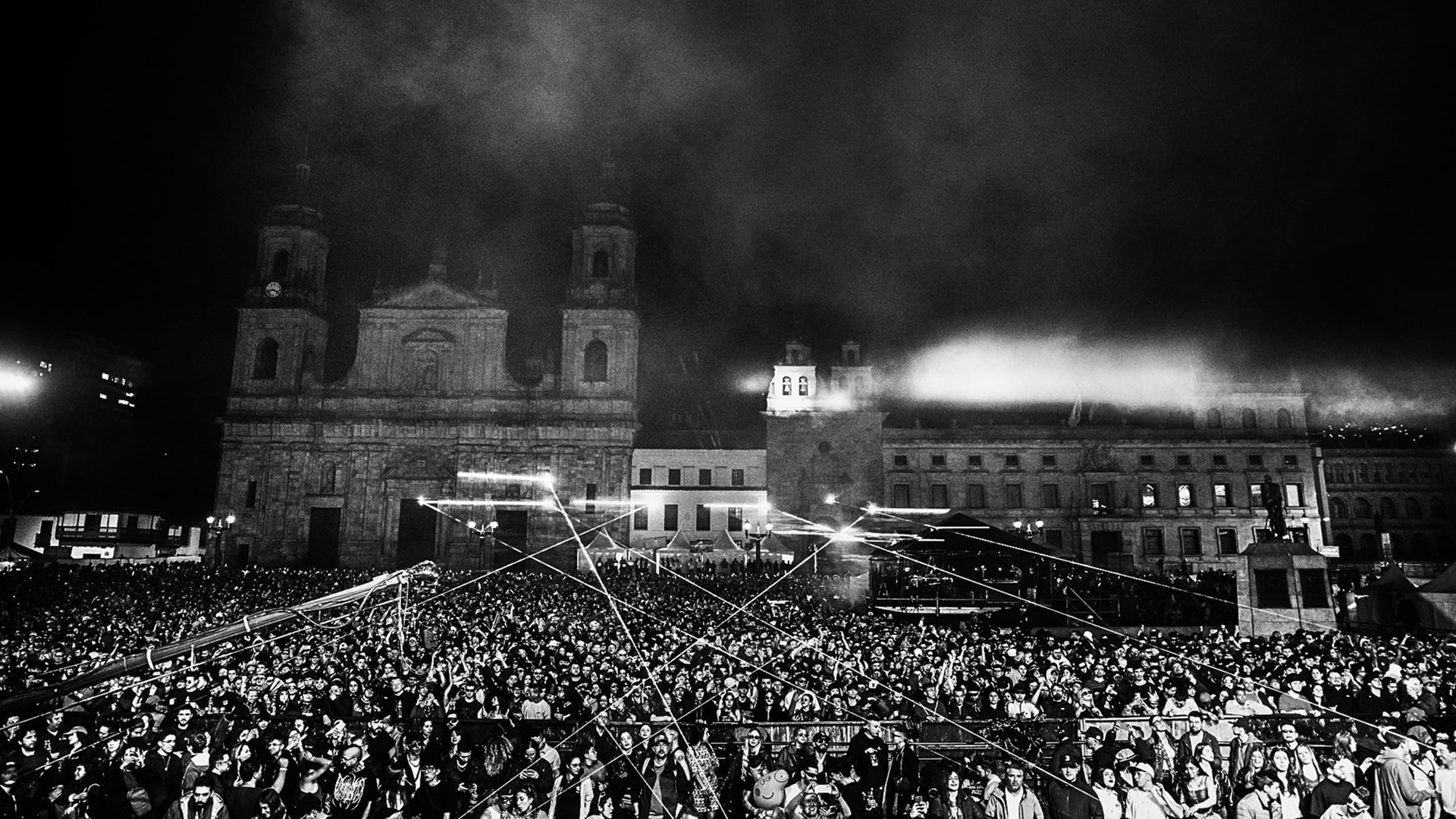
Una Rave en la Plaza
On July 25th, Bogotá turned Plaza de Bolívar into a dancefloor. Surrounded by the Capitolio Nacional, the Palacio de Justicia, and Palacio Liévano, home of the city’s government, the square hosted the fifth edition of Monumentum: Bogotá Distrito Rave (the third to take place there). Doors opened at 1pm, the music ran until 9 and entry was free to anyone over 18 until the square reached capacity.
If the significance of that isn’t already obvious, Plaza de Bolívar is not a park or a festival ground. It's the most symbolically loaded public space in Colombia; it’s used for presidential inaugurations, protests, and national mourning. And for one Saturday a year it becomes Monumentum, a free electronic music festival, backed and organised by the city government itself.
This makes you wonder how Bogotá’s electronic music culture went from hidden after-hours parties and unmarked doors to taking over the capital’s front room.
Before the City Became a Dance Music Capital
To answer that, you have to go back to a much smaller, much less official Bogotá.
In the early 1990s, electronic music in the city lived almost entirely at Cinema, the only club of its kind at the time, plus after-parties thrown by a collective called Morrocco, DJ Connection nights, and secret after-hours parties hosted in houses around Chapinero. Cinema was run by the Pachón family, and Gerardo Pachón was one of the most recognised trance and techno DJs of the period. Having music to play wasn’t simple. DJs depended on vinyl, a lot of it brought back personally from trips abroad. Information about upcoming parties circulated through street flyers rather than anything digital.
Then, in 1995, the city government accidentally gave the underground a gift. Bogotá’s mayor at the time, Antanas Mockus, introduced the “ley zanahoria”, a law banning alcohol sales between 1am and 6am. With clubs being forced to close early, this restriction ended up fuelling the underground culture it was trying to contain. During Mockus’s second term in 2002, more venues began registering as private social clubs to work around the rule, so he extended legal nightlife hours to 3am, which is still the case in most areas today.
The 2000s turned that underground into something with its own social conscience. Pioneers of the 90s and 2000s scene, DJs Sonico and Dani Boom ran Bogotrax, a ten-day festival that combined electronic music with art, culture and social action. It took music into neighbourhoods like Ciudad Bolívar and prisons: La Modelo, the Cárcel Distrital and Buen Pastor. The festival eventually closed after a decade, but the instinct it represented, that this music belonged to the whole city, not just the parts with money, never really left. There is an obvious echo of that philosophy today in Monumentum.
It’s worth adding that Bogotá’s relationship with electronic sounds began long before any of this. Long before Cinema or the first drum machine showed up in a Chapinero living room, composer Jacqueline Nova was working with tape machines in the late 1960s, manipulating chants of the Indigenous U’wa people with electronic circuitry in pieces like Creación de la tierra. This could’ve been the first time anyone in the city treated electronics and local sound as natural collaborators rather than opposites. That idea would resurface, in very different forms sixty years later.
For much of its history, electronic music in Bogotá developed around, alongside, and sometimes in spite of the institutions governing nightlife. Monumentum shows something has changed: the city is no longer simply regulating electronic music culture, It’s creating it.
Where the Underground Found a Permanent Home
Walk through Chapinero on a Friday night today and the lineage from those 90s after-hours parties is hard to miss.
Video Club, which is tucked into the heart of Chapinero between XXX cinemas and half a block from the Iglesia de Lourdes, has built its reputation on being unfiltered: no dress code, no door policy beyond the vibe, people arriving in heels, sneakers, suits, and drag all get the same welcome. Its programming is heavy on house, tech-house, and groove, and it also hosts a recurring LGBTIQ+ night called Gostoso.
A few blocks over, Octava, founded in 2015, is more of a sensory experience than a straightforward club. It’s a three-floor space where two floors host the music and the third is a smoking terrace designed for conversation. It draws a slightly older, house and deep-house / tech crowd. It was also included in DJ Mag’s 2021 Top 100 Clubs.
Gate and Kaputt, both also based in Chapinero and typically running from Wednesdays, lean into a darker, more Berlin-influenced atmosphere: the harder, more experimental side of trance and techno in Bogotá. Radio Berlín, true to its name, lives in the same lane, and is still one of the clubs most associated with the city’s techno scene.
What’s changed isn’t really the clubs themselves; it’s their status. All five of these venues are now listed as allied clubs of Monumentum, working with the city government, the Bogotá Chamber of Commerce, and a DJ group run through the local bar association. Venues that spent decades operating in the same self-contained way clubs everywhere do are now officially part of the infrastructure the city points to when it talks about its creative economy.
There Is No Single "Bogotá Sound"
Ask what Bogotá actually sounds like and you’ll get a different answer depending on the night, the club, and the decade you’re asking about.
“The real difference between Bogotá and the rest of the world sits in its underground”
— Sonico
Sonico is one of the scene’s longest-running figures and he calls Bogotá the capital of hardcore and drum & bass in Latin America. This claim would surprise nobody who’s spent a night at one of the city’s harder parties. But that’s only one current among several. Bogotá has a hardcore and gabber scene that has thrived for years, built by a generation of young ravers who rejected established house and techno for high-BPM, distortion-heavy sets. Meanwhile, entirely separate rooms are dedicated to ambient and experimental listening, trance nights pull their own crowd, and guaracha, the raw, high-tempo sound that’s spread across Latin America in recent years, exists alongside all of it without anyone treating that as a contradiction.
So the more useful question isn’t “what does Bogotá sound like.” It’s what makes all of these different sounds recognisably Bogotá at all, and the honest answer has less to do with a defining sound than with a shared attitude: intensity over polish, a comfort with extremes, and a scene small enough that a hardcore raver and a deep house regular are probably standing in the same club at some point during the week.
Making Imported Music Local
The more interesting question is what happens once all of that imported sound actually lands in Bogotá. For a long time the honest answer was that not much changed at all.
Producer Dani Boom has talked about how the city put enormous weight on anything imported, while undervaluing its own musical culture. He described it, in retrospect, as something close to a colonised mentality. The person he credited for shifting that was Richard Blair, a British studio engineer and Peter Gabriel collaborator who founded Sidestepper with Colombian singer-songwriter Iván Benavides in Bogotá in 1996, creating productions out of local musicians and local styles. This project became one of the biggest influences on Colombian electronica and helped open the door for what followed. Around the same period, DJ and producer collective Bollo Room started throwing parties that mixed calypso, cumbia, champeta, old-school reggaeton, and salsa in with straightforward techno sets. Crate-digging archivists like Mario Galeano pushed traditional Colombian folk styles back into the rooms that had mostly been playing records from somewhere else.
That thread runs straight into what’s happening now, just with different tools. Bogotá producer Gregorio Hernández de Alba, who records as dj +1, has spent recent years producing albums out of deeply personal, specifically local material: one record inspired by the herbal teas his mother made to get through Bogotá’s shifting seasons, another blending Latin American rhythms directly with techno, phonk, and UK garage. None of it reads as a gimmick or a marketing angle. It reads like an artist genuinely uninterested in choosing between “international sound” and “where I’m actually from”.
That’s probably the clearest evidence that Bogotá has moved past the anxiety Dani Boom once described. Nobody currently defining the city’s sound seems to be asking whether they’re allowed to sound like themselves.
From Underground to Cultural Institution
Which brings the story back to the plaza.
Monumentum began in 2022 inside El Bronx, Bogotá’s Bronx Distrito Creativo. It was a red-light and crime-affected district turned into a cultural redevelopment zone. The second edition moved to the larger Plazoleta Jorge Tadeo. Over its first four editions, the event drew roughly 42,000 people and more than 25 artists, establishing itself as one of the country’s leading platforms for making electronic music visible.
The 2026 edition ran from July 22nd to 25th, combined the Saturday party at Plaza de Bolívar with a separate, free academic strand called ¡LAB. This was open to anyone who registered in advance and featured sessions on the professionalisation of artistic projects, the creative economy, audience-building, technology, and the future of electronic culture. Alongside the music, a selection of twenty local food, drink, accessories, fashion and design businesses ran a commercial zone as part of the city’s “Hecho en Bogotá" (Made in Bogotá) economic development strategy.
And then there’s the detail that actually changes the shape of this story. This year’s edition came with the approval of a formal policy agreement that institutionalises Monumentum as “Bogotá Distrito Rave”, transforming what started as a single party into an official public policy aimed at strengthening electronic music in the city. FUGA director Blanca Andrea Sánchez described it as proof that when the public sector works in coordination with industry, clubs, academia, and cultural organisers, it becomes possible to build platforms that create real opportunity throughout the creative ecosystem.
It’s a genuinely rare thing: a scene that spent its first two decades defined by secret parties and workaround alcohol laws now has a place in the city’s cultural policy. Whether that’s an unambiguous win depends on who you ask. Institutional backing brings resources, legitimacy, and reach that no festival could generate by itself. However, if handled carelessly, it could sand down the rough edges that made the underground worth protecting in the first place. What’s notable about Monumentum so far is that it hasn’t tried to replace the clubs, it has chosen its lineup and programming around the existing ones. Hopefully this balance holds as the policy framework matures.
The People Keeping It Moving
Underneath the institutional story are the people it’s actually about.
Keith Barrera’s story started at home. Her father, Carlos Barrera, was a well-known DJ in Bucaramanga and taught her to love music and the craft of mixing. She’s been rising fast since 2019, and this year became the first Colombian artist represented by the European agency TRIVIAL Bookings. She arrived at Monumentum off the back of shared lineups with Sara Landry, CamelPhat, Ellen Allien, Fatima Hajji, and Charlie Sparks. She played this year’s Plaza de Bolívar edition through a partnership with Páramo Presenta.
Pao Calderón represents a different generation. She has been producing and DJing for over a decade, has multiple wins as Colombia’s best DJ and runs her own label, DTL Records. She arrived via her home club, Octava.
Diossa plays sets that draw from techno, afro house, and indie rhythms without settling into any one of them. Her roots are Colombian, but she developed through Miami’s clubs, and is now based in New York. She headlined alongside Barrera and Calderón and, together, the three showed different versions of what international reach can look like for Colombian artists.
Further down the bill, Linda Lenor, who is a Bogotá-born, Madrid-based DJ, producer, and founder of Cosmic Music Records, represented Gate Club. Dankz carried Radio Berlín’s hard techno identity and Saradélica brought VideoClub’s blend of house, breaks, and Latin American sound into the mix.
Maybe the most telling detail of all sits underneath the confirmed names. This year’s Talent Search (the open call that gave one emerging DJ the job of opening the festival) pulled in more than 140 applicants from around the city, narrowed down to 24 semifinalists, four reached the final showcase, and the winner, The Corrosive, opened the Plaza de Bolívar on July 25. The prize also went beyond the set: it included training, mentorship, professional video production, and future performances.
What Does Bogotá Sound Like Now?
It’s tempting to end somewhere tidy — to land on a genre, a BPM range, a defining trait. Bogotá doesn’t really allow that, and by now it should be clear why.
What Bogotá has is a scene confident enough to host hardcore and ambient, guaracha and melodic techno, the after-hours culture of 90s Chapinero and a government-backed policy all at once, without treating any of it as contradictory. It absorbed British sound engineers and darker techno influence from Berlin and made something that still, unmistakably, sounds like it comes from here, not because it resisted the outside world, but because it stopped being anxious about letting the outside world in.
Plaza de Bolívar, on July 25th, was really just that idea made physical: a festival hosting the sounds that used to hide from any kind of official attention. Electronic music that once depended on unmarked doors and secret locations now has a place, once a year, right in the middle of everything.
That’s not a genre. It’s a city deciding what it’s confident enough to do in public.
Sourced from The Bogotá Post, Bogotá's official city government site (bogota.gov.co) and FUGA's own newsroom, Infobae, Rolling Stone en Español, Electronic Groove, Mixmag, Remezcla, Bandcamp Daily, Vice, and artist bios via Beatport, Resident Advisor, Exetra Records and Colombia Electrónica.