

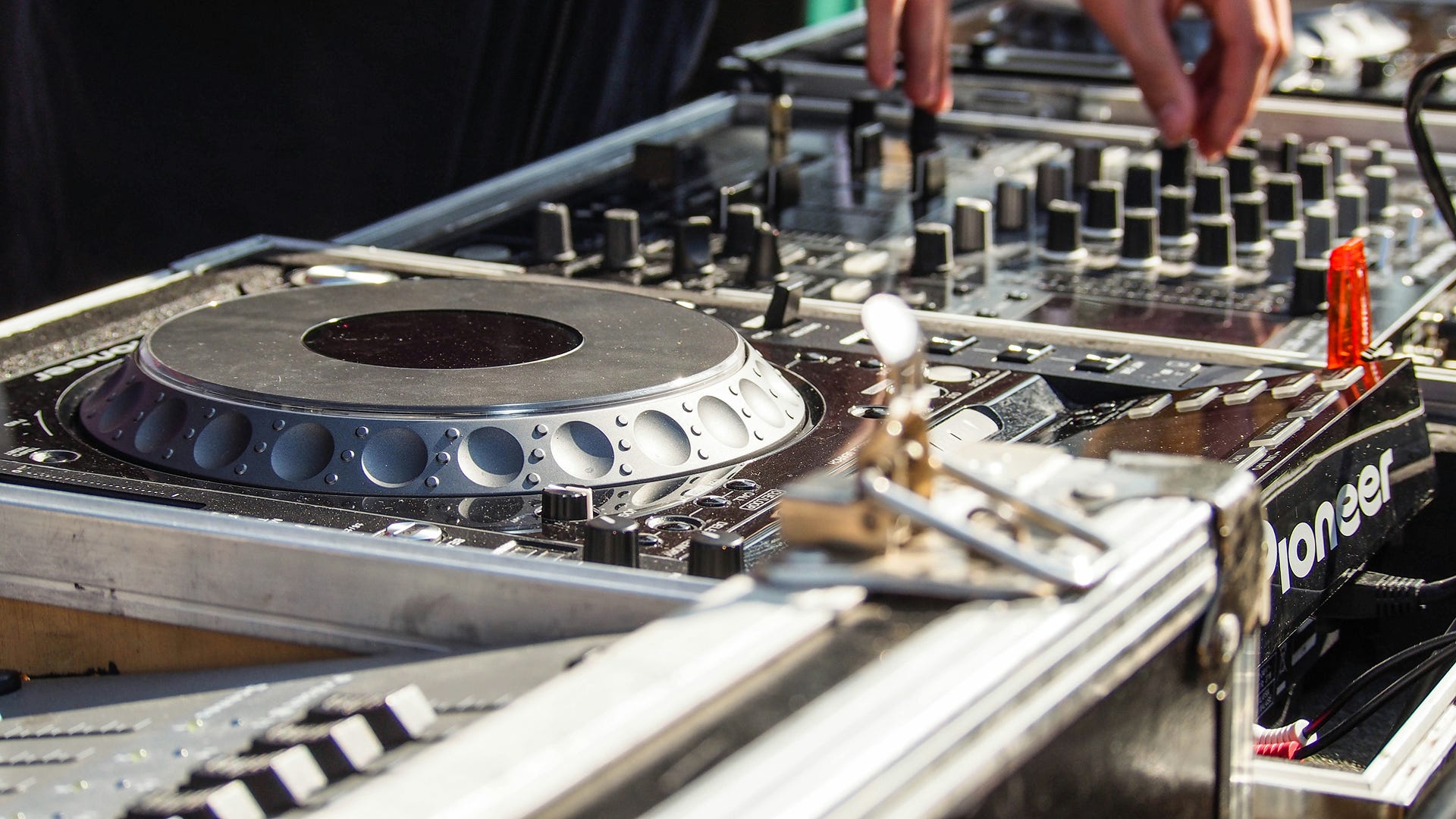
Walk into any booth worth playing in and you’ll find the same ritual. The DJ plugs something in. For twenty-odd years, that something has been a USB drive carrying thousands of decisions made long before the audience stepped through the door. The tracks selected, the cue points marked, the waveforms analysed, the crates organised. Everything compressed into a device small enough to lose down the back of a sofa.
That ritual is changing.
Last autumn, AlphaTheta announced that Rekordbox now supports direct Spotify playback. Over a hundred million tracks, accessible within the same software used in pretty much every club. Apple Music had already integrated with DJ software earlier in the year. Pioneer’s latest flagship player, the CDJ-3000X, arrives with streaming built directly into the unit. Beatport has been operating its own streaming tier for years, purpose-built for DJs, available inside Rekordbox, Serato, Traktor, and a growing list of standalone hardware.
You can now, in theory, walk into a booth with nothing but a login and start mixing.
The assumption that you’ll need a USB is eroding. And if the music no longer has to travel with the DJ, the question worth asking isn’t about the format. It’s about what formed around carrying it, the habits, the economics, the culture, and the identity and what happens to all of that now.
From Record Bags to USBs
DJs have been through a version of this before. The shift from vinyl to digital was not a single event but a slow, contested shift in what it meant to turn up to a gig prepared. For a long time, carrying records came with limits. The physical constraints were real: a bag could only hold so many twelve-inches, and every slot was a choice. You learned your records because you had to. The grooves became familiar. The sleeves and centre labels were a physical form of memory, each one a marker of something earned financially, over time, or emotionally.
USBs dissolved most of these limits. Thousands of tracks in your pocket, travelled light, arrived with cue points already set and waveforms pre-analysed. The library expanded. The preparation became more technical in different ways: colour-coding crates, building playlists, exporting for the hardware waiting at the venue. DJs could carry everything without abandoning the principle of deliberate selection. They still owned the music, every track on a USB had been purchased, downloaded, and brought into the room as something belonging to the person carrying it. (Soulseek and dodgy rips are a separate conversation.)
The move from records to USBs changed how DJs carried their music. The move from USBs to streaming could change whether they own it at all.
This matters more than it seems. When the format changed from vinyl to digital, digging survived. The commitment needed to find music, the hours spent in shops, on Juno Download, through Bandcamp pages, label mailing lists and recommendations between friends remained. Streaming changes the character of that commitment in ways that are starting to become clear.
Is Digging Still Part of DJing?
Ask almost any DJ who came up through the late 90s / early 2000’s and they’ll tell you digging is the most important part of the craft. Not just finding music, but the specific relationship that forms with the music you’ve committed to. When a track costs a couple of quid and you’ve bought it off a label’s promo list, or because you caught it in someone else’s set and spent three days tracking it down, it creates an emotional connection that something surfaced by an algorithm while you were scrolling doesn’t.
Streaming does not kill discovery; that would be a lazy conclusion. Beatport’s streaming catalogue is purpose-built for it. DJs can search huge archives from inside the booth. Connected systems can suggest music related to what is already playing. This is a form of discovery, but its character is different.
When the booth starts suggesting what to play next, where does the platform’s taste end and the DJ’s begin?
Algorithmic recommendations are decided by what has already worked, not just for one DJ, but through the entire mass of user data informing the system. The track you found on an underground label’s Bandcamp page at midnight, limited to two hundred copies, does not feature in algorithmic logic. The promo a producer sent you directly because you supported their last three releases is outside the catalogue entirely. The white-label test pressing that a collector passed along has no metadata.
None of this is new territory for anyone who has watched the music industry wrestle with streaming over the past decade. But for DJing specifically, where the difference between using a platform’s selections and demonstrating your own has always been central to the culture. Private edits, vinyl-only releases, tracks bought directly from artists and never available on any major platform: these are the things that have always separated a selector from someone who presses play on a playlist. They may become more culturally significant, not less, precisely because they do something an algorithm can’t.
When Every Track Is Available, Taste Matters More
The practical arguments for streaming in the booth are not trivial. A DJ who streams can react to a crowd moving in an unexpected direction without owning the music that direction needs. Testing an unfamiliar track comes at no cost, so flexibility has become unlimited.
There is also an economic argument that makes streaming more attractive, especially for DJs early in their careers. Owning a serious library of purchased downloads is expensive. At Bandcamp’s standard pricing, regularly buying music quickly adds up. For a DJ who doesn’t earn enough from gigs to offset that outlay, streaming access to the same catalogues at a monthly subscription rate is a game changer.
But abundance creates its own problems.
Decision fatigue is real, the paralysis of too much. A USB with five hundred carefully chosen tracks demands a different kind of mental engagement from a catalogue of a hundred million. You know what you have and you know which version of a track you’re playing, why you chose it over another, how it has been received before. That familiarity is part of what makes a DJ adaptable. The size of the library is not.
The homogenisation risk is also worth taking seriously. If most DJs that play a given genre are drawing from the same streaming catalogues, guided by the same charts and algorithm-driven recommendations, the difference between sets begins to flatten. What becomes genuinely rare is judgement: the ability to know music deeply, to understand how a track sits at 3am versus midnight, to carry a relationship with it that goes beyond having pressed play on it once.
“The people I find most interesting to listen to are the ones where you can tell they’ve lived with every record they play. You can hear the difference between someone who owns their music and someone who’s browsing it.”
— A UK DJ and label owner with more than two decades in dance music
A DJ who understands five hundred tracks deeply could be more adaptable, and more distinctive, than someone who can search millions but knows very few properly.
Your Library Is Not Entirely Yours
The legal and technical world of streaming DJing is murky. A streamed library depends on an active subscription, a reliable internet connection, compatible hardware and software, the continued availability of each track on the platform, and the platform’s ongoing support for DJ equipment. Any one of those conditions can fail.
The internet problem is very relevant for underground venues. Festivals, basement clubs, converted railway arches, and warehouses are not reliably connected spaces. Signal drops, and the Wi-Fi can’t always handle a crowd. Spotify’s integration with Rekordbox and Serato, launched last autumn, currently has no offline mode. This means any DJ relying on it needs a live connection throughout their set. Beatport’s streaming tier includes an offline locker, but this is restricted to software-based setups; CDJ users can’t access it.
Then there is the question of what happens to tracks. Music disappears from streaming services without warning, for reasons like licensing disputes, label changes, and deliberate artist withdrawals. The wave of artists and labels who removed their catalogues from Spotify following revelations about CEO Daniel Ek’s substantial investment in Helsing included many in electronic music. Kalahari Oyster Cult, the Amsterdam-based electronic label, stated they did not want their music benefiting a platform whose leadership backed tools of war. Massive Attack described it as a moral and ethical burden placed on artists by the economics of streaming. These withdrawals matter for listeners; for a DJ who has worked on a set featuring tracks from those catalogues, a quiet Sunday removal can become a live problem on Friday night.
The comparison with USB ownership is not a clean one though. Downloaded files are not perfectly independent either because they rely on library software that requires maintenance and compatibility, so they can corrupt or fail like any other data. USBs can be lost, stolen, formatted incorrectly, or exported in a format incompatible with the hardware at a venue.
This is not a choice between complete ownership and complete dependence. It is a choice between different kinds of control, and different things that can go wrong. Knowing which failure you’d rather face at two in the morning is probably the most honest framing.
Sitting beneath all of it is a contractual grey area where the technology has moved faster than the law to resolve it. The terms under which a DJ can use a consumer streaming subscription for professional performance are not the same as the terms governing a track purchased and downloaded. The venue’s music licence and the DJ’s streaming account are not interchangeable. The industry is moving towards streaming in the booth before the legal foundation for it is fully settled.
What Producers Gain and Lose
The shift from downloads to streaming does not only affect the person behind the decks. It restructures the economic relationship between DJs and the producers whose music they play.
Under the download model, a DJ is a direct customer. A track purchased from Bandcamp generates a clear, one-time payment to the rights holder. This is usually somewhere between £1 and £2.50 per download, with roughly half going to the label and artist after distributor commission. It is not a fortune, but it is a concrete transaction and investment in the music being played.
With a streaming model, that relationship becomes recurring in theory but fragmented in practice. Every play generates a fraction of a royalty, already thin on even the most generously structured platforms, and rates vary month to month depending on total catalogue usage. For major label artists with millions of plays, streaming income is real. For the small independent producers, the payoff is considerably worse.
Beatport has positioned itself as the streaming platform for DJs, and its CEO has spoken publicly about not treating DJs like any other consumer. But even the most sympathetic platform is operating within streaming’s structural logic: pooled revenue distributed proportionally, with rates that reflect relative catalogue size as much as cultural significance.
The tension this creates is real. Are DJs becoming recurring listeners who generate some ongoing value each time they play a track, or disappearing as paying customers who once made a direct investment in the music they used? For a producer whose relationship with their audience was partly built through the DJs who bought their records and played them live, the difference is not only economic; It’s relational.
Bandcamp, which has been a refuge for direct artist-to-fan economics and has paid out over $100 million annually in direct-to-fan sales, becomes more significant in this context. As the mainstream catalogue becomes more accessible by subscription, the gesture of buying a track directly from an artist carries more cultural weight than it once did. It signals something that a stream never can.
What Streaming Can’t Replace
There is a corner of every serious DJ’s library that no streaming service has ever touched.
Unreleased promos sent directly from producers to the DJs they trust. Personal edits: unofficial, uncleared, produced for a particular moment in a specific kind of set. Tracks bought from artists at a merchandise table after a live show. Vinyl-only releases that were never digitised. Music removed from platforms years ago, preserved only in the collections of people who bought it at the time. Regional and obscure catalogues that have never made it onto a DSP.
These are the materials that have always defined the boundary between a DJ who uses music and one who carries it. No subscription provides access to a producer’s unmastered demo sent by email to thirty trusted people, and no algorithm surfaces the EP limited to thirty copies. These things need relationships with labels, producers, other DJs, and scenes that streaming does not provide and cannot replicate.
That’s where the debate contradicts itself. As the mainstream catalogue becomes universally accessible, the music outside it becomes a stronger sign of identity, not a weaker one. The easier it becomes to reach the same tracks as everyone else, the more valuable the unreachable ones become.
This is not nostalgia for scarcity. It is a recognition that scarcity has always been what sets DJs apart.
The USB Isn’t Dead. Its Meaning Is Changing.
This article didn’t begin with the prediction that USBs are finished, and it will not end there. The reality of most club systems (the CDJ) means USB compatibility is not disappearing any time soon. DJs who stream at home will still arrive at most venues with a USB.
What has changed, or is changing, is what a USB represents. For twenty years it has been the expected container for a DJ’s musical identity: the physical proof of decisions made, music owned, preparation done. That expectation will no longer be universal. The USB has become a way into the booth rather than the only one.
When vinyl gave way to digital, the fears were familiar: that digging would die, that selection would collapse, that musical identity would flatten. It did not happen. The format changed; the commitment to the music didn’t necessarily follow. That earlier transition was about how DJs carried their libraries.
A library built carefully over ten years, accumulated through deliberate purchasing, organised to reflect how a DJ thinks about music, carrying the tracks that only that combination of taste, access, and effort could have produced, is not something that can be recreated by subscribing to something. It is built under conditions of scarcity. Those conditions shaped the library and the library shapes the set.
Streaming is here and it won’t leave. For some of what DJing involves: discovery, flexibility, and access for those earlier in their careers, it represents a genuine expansion of possibility. For the parts that make DJing what it is: the preparation, the deliberate selection, the accumulated knowledge of music carried over years, it raises issues that have not yet been answered.
The end of the USB may still be a long way off. The end of the assumption that being a DJ means selecting the music you play may have already begun.