

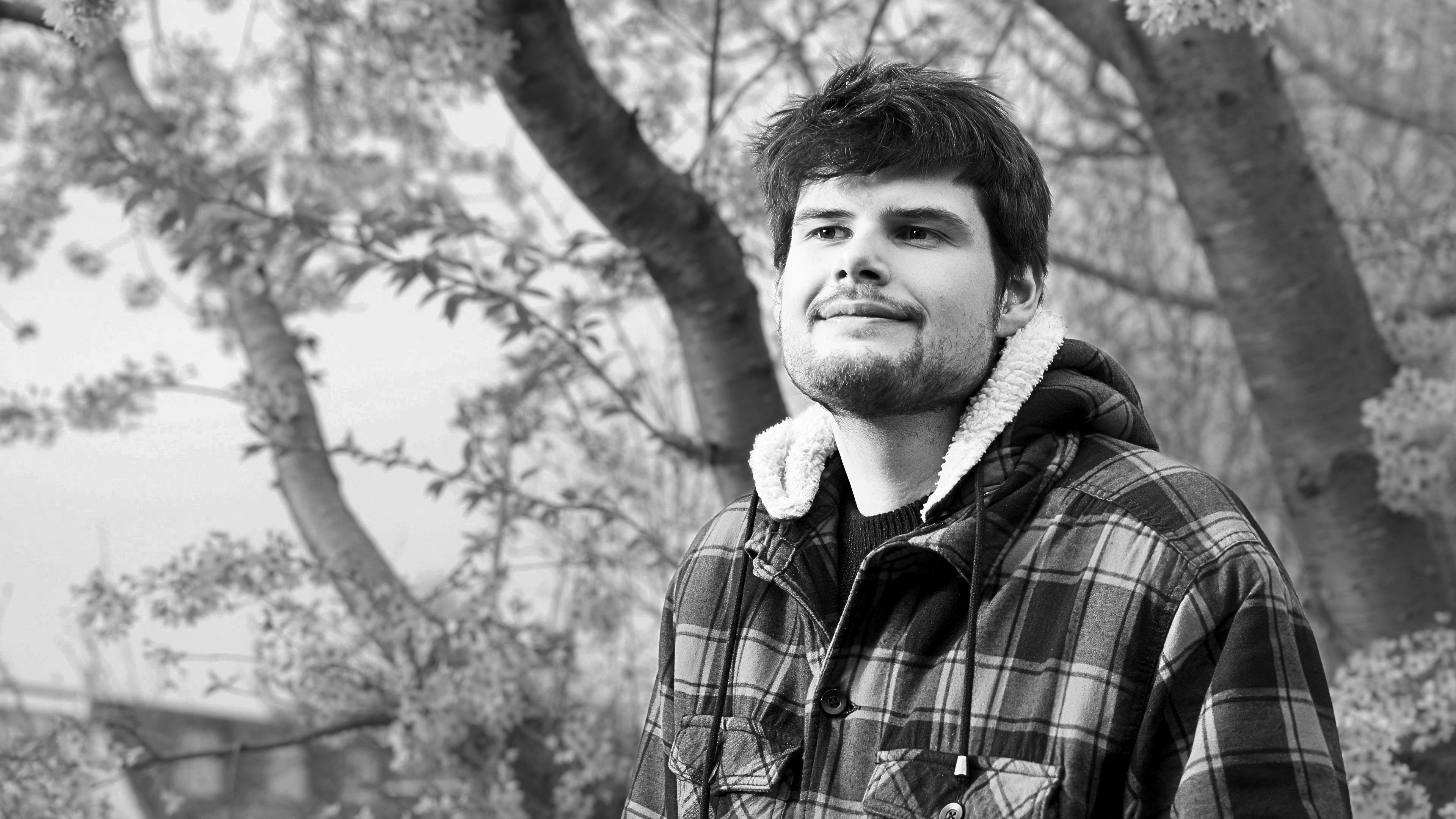
Dutch producer and DJ Edlan has been releasing drum & bass since 2016, with music on Liquicity, Integral, Fokuz and Pilot. His debut album, Landmarks, arrived in 2021, exploring melody, atmosphere and sounds connected to places and memories.
But knowing what he wanted to produce didn’t always mean feeling sure enough to release it. When labels were lukewarm on his demos, he began to doubt whether the music was good enough, and repeating what had worked before started to feel like the safer option.
That’s starting to shift. His recent releases 1000 pages, Healing and Falling Faster have pointed towards something brighter. He’s also keen to bring indie influences into his songwriting and work more with live instruments. We caught up with Edlan to discuss that shift, the experiences behind his music, and where he wants to take it next.
Trusting His Music
On your website you write that for a while you “mistook silence for staying true.” What helped you get comfortable sharing the music you’d been holding back?
Courage, I guess. And not expecting as much anymore.
I used to be really afraid of what labels thought of my music. If a label wasn’t enthusiastic about something I made, I immediately assumed it wasn’t good enough and that I shouldn’t release it. And when you think like that, you end up repeating the things that worked before, because taking risks starts to feel dangerous.
I also think Drum & Bass can be quite conservative. Sometimes it feels like one part of the scene keeps making the same commercial dancefloor music, while another part tries to recreate the feeling of the 90s.
And I respect both approaches. Amazing artists are doing those things. But personally, I’ve always wanted to think a bit differently and outside the box.
At some point, I realized I was letting other people’s expectations decide what Edlan was supposed to sound like. And that’s quite strange when you think about it, because making music is such a personal thing.
I think I’ve become less afraid of making something that doesn’t fit. I’d rather release music that feels honest to me, even if it doesn’t get the response I hoped for, than keep sitting on things because I’m afraid someone won’t like them.
Looking back at “Landmarks”, what do you still recognise in that record as part of your sound, and what feels different about the artist you are today?
Landmarks was such an interesting era for me. I have some really great memories of it, but also some pretty bad ones. I released it during lockdown, while I was in the middle of a challenging relationship. I remember feeling really proud. Having my first solo album on vinyl sell out was a huge achievement for me.
But at the same time, I was really struggling with my own head and insecurities. It was weird to experience something so amazing in my music career, and then break down an hour later because of relationship problems, or because it felt like seeing people and having a normal life was a thing of the past due to the virus.
It was a really difficult but also beautiful time in my life. And weirdly enough, I think I enjoy expressing that contrast between happiness and sadness through music.
My sound has changed a lot since then. Back then, I was much stricter with myself and had a lot of rules about how I should make music. I wanted to stay respectful to the scene and honor artists like Calibre and Lenzman, while also trying to bring in things I loved myself.
Right now, I’m living in a very different reality. I don’t feel that same need to stick to a sound that already exists. Instead, I want to combine all the things I love, even if they don’t necessarily belong together according to the rules of a genre.
I’ve also been through therapy and moved on from people who were holding me back, whether intentionally or unintentionally. I think I’ve become much more comfortable with who I am, as a person and as an artist.
And maybe that’s the biggest difference. I now allow myself to make and release what I actually want, instead of constantly worrying about whether it’s credible enough.
“At some point, I realized I was letting other people’s expectations decide what Edlan was supposed to sound like.”
— Edlan
The Stories Behind the Releases
“Leap of Faith”, “Healing” and “Falling Faster” have all come out on Liquicity this year, and all three are collaborations. Is there a connection between these releases, or does each capture something different for you?
They are definitely connected. All three share a theme of hope, change and trying to be honest about life.
There’s quite a personal story behind these tracks. I wrote them during a period when a lot was changing for me. I had moved to a new place, and musically I wanted to move away from making strictly deeper liquid and explore something more uplifting, melodic and pop-inspired.
I was really excited about that direction, but the journey turned out to be much harder than I expected.
I started working with different songwriters and producers, trying to develop a new sound. Sometimes it worked really well, but other times there were egos involved, creative disagreements, or decisions being made that I didn’t really connect with. Labels were also declining demos, and slowly I started losing confidence in my own vision.
I remember being so excited about what I was making, only for things to fall apart later.
Eventually, it got to the point where I started feeling genuinely sick and lost in my career.
At the same time, the music industry was changing. Labels and YouTube channels that used to have a huge impact were becoming less influential, streaming algorithms were changing how people discovered music, and now there’s also the uncertainty surrounding AI.
Edlan had always been a sort of safe space for me, especially around 2021 and 2022. But suddenly, even that started to feel uncertain. My monthly listeners on Spotify were declining, and I started questioning whether I was doing something wrong.
I blamed myself for a lot of it. Looking back, I realize that many artists have been dealing with similar changes, and that it wasn’t all something I could control.
From late 2023 through 2024, I decided to really focus on making music that I personally loved. I wanted it to feel happier, more uplifting and more personal lyrically. I contacted lots of songwriters and producers, but this time I made sure I remained the main producer and creative director of the songs.
I was still dealing with a lot of health anxiety during that period, partly because of the stress of moving out and feeling uncertain about my future. Music was both something that made me anxious and something that helped me get through it.
And that’s why these releases mean so much to me. They’re not just a new musical direction. They remind me of a time when I was struggling quite a lot, but still trying to create something hopeful.
I’m in a much better place now, and it feels really good to finally release the music I made during that time.
Could you pick one of those tracks and talk us through how it developed? What was the first idea, and was there a moment when the direction clicked?
Healing is probably a good example because I made the first idea during one of the most difficult periods of my health anxiety, although luckily it was also getting close to the end of it.
I remember having a really nice time at a park the day before. I wanted to make a DnB tune again, partly inspired by that feeling. But there was also a virus going around at the time, and I was constantly anxious and scared about getting sick.
So I basically locked myself in the studio and tried to make something soothing. Something that could take my mind away from everything I was worrying about.
That became the initial idea for Healing.
Later on, when I was collecting demos and ideas, I came across that little sketch again, and something about it still felt special.
I thought it would be cool to work on it with my good friend Benito Diablo. He added elements that really enhanced the track and helped bring it to life, while I focused on the production and mixing decisions.
I think what I love about that track is that it came from such an uncomfortable state of mind, but the music itself feels quite comforting. That’s something I really like about making music. Sometimes you can turn a really unpleasant feeling into something beautiful.
How did the collaboration on Falling Faster , with Capturelight and Alec Primavera come about, and how did each of your ideas shape the final track?
My first dancefloor-ish release!
I started the idea in early 2024, during one of those days when I suddenly had a little burst of happiness and energy, despite all the anxiety I was dealing with.
It only lasted a few hours, but I managed to get an idea going.
Later, I sent Capturelight a DM with that old demo, and he really helped turn it into something. He managed to save the original idea and melody I had, and transformed it into a proper banger.
Out of my last four releases, this one is probably the lightest in terms of its themes. I wanted something danceable and energetic, but that still felt connected to the music I was making at the time.
I sent the track to Alec Primavera, and he came back with ideas really quickly. After that, things moved pretty fast.
It was actually quite a refreshing collaboration because it felt relatively easy once the pieces started coming together. Capturelight really helped make the production work, and Alec brought in what the song needed vocally.
I’m really happy with how it turned out, especially considering how small and spontaneous the original idea was.
“Sometimes you can turn a really unpleasant feeling into something beautiful.”
— Edlan
Influences, Emotion and Production
What first pulled you to melodic drum & bass, and what keeps you connected to it now?
It’s been a long time, and honestly, I’ve always loved melodic music the most. I think it was around 2015 when I started getting into liquid, after being more into Noisia and that kind of stuff. Back then, Etherwood was really becoming big, and his tunes made me fall in love with the sound. Around the same time, Dawn Wall released their first EPs, which of course influenced my sound a lot too.
Lately, I’ve actually felt a bit disconnected from Drum & Bass in general. Not because I don’t like it anymore, but because I’ve discovered so much music outside the genre. I’ve been listening to a lot of indie, alternative and other stuff that has really changed how I look at music.
But today I was listening to some Hybrid Minds again, and it reminded me of everything I love about Drum & Bass. I think that emotional feeling is what keeps bringing me back.
When you’re chasing a feeling in a track, how do you turn that into production decisions? Is there a small detail in one of your tunes that does more work than listeners would realise?
One thing I’ve always focused on is the bigger picture, rather than all the cool individual elements in a track.
I think a good song needs cohesion. Everything should feel like it belongs together, instead of just being a collection of impressive sounds, production tricks or ideas that don’t really make emotional sense together.
Something I absolutely love using is real recordings. Instruments, of course, but especially field recordings.
I already did this quite a lot on Landmarks. For me, a field recording can make a song feel like it’s connected to an actual physical place or a memory. It makes the music feel less abstract somehow.
For example, I remember sampling a recording of someone walking through a specific place in France. It was just an iPhone video, probably with fewer than 100 views on YouTube.
I could have gone to Splice and found some perfectly recorded footsteps or ambience, which I also do sometimes. But there’s something special about using a recording that actually came from a real place, with all its imperfections.
I’m really fascinated by how sounds can trigger memories or feelings you can’t quite explain. Sometimes a certain ambience or texture reminds you of somewhere you’ve been, or even somewhere that doesn’t really exist outside your imagination.
I think I should start recording more videos when I’m walking through nature or visiting interesting places, and use the audio in my tracks.
I also love combining those recordings with lo-fi tape effects, degraded textures or even deliberately low-quality MP3 encoding on melodic elements. That kind of imperfection can create a really specific feeling.
Sometimes those tiny details are what give a track its identity, even if the listener doesn’t consciously notice them.
What are you taking inspiration from outside drum & bass right now? Is there anything you’re trying to bring into your music that you haven’t explored before?
There are so many artists I love right now. acloudyskye is probably my favourite artist at the moment. I also listen to a lot of Flawed Mangoes, your warm arms, American Football, Novo Amor, and more pop-oriented artists like The Midnight, Coldplay and The 1975. I could honestly go on for ages.
The tracks I’m releasing now, which I mostly made in 2024, were very inspired by Porter Robinson and Botanica.
But looking towards the future, I really want to explore making Drum & Bass more indie, and maybe even emo.
I’ve started to really love guitar. I’m not much of a guitar player myself, but I love working with people who can play well, and I love the emotional qualities of the instrument.
I think my vision is to create something that feels less like traditional liquid or dancefloor music, and more like actual indie songs that happen to use Drum & Bass as their foundation.
Songs that people connect with emotionally, not just because of the atmosphere or the drop, but because of the songwriting itself.
Right now, I feel like Drum & Bass is still often seen as either something heavy and energetic for ravers, or something deeper and more atmospheric to chill to. And there’s nothing wrong with either of those things.
But I think there’s so much more room for emotional, indie-inspired, songwriting-driven music in this genre.
I’d love to hear more real instruments, unusual song structures, intimate vocals, guitars, and things that might not immediately sound like they belong in a Drum & Bass tune.
That’s really what I want to explore with Edlan.
Of course, breaking out of an existing mold isn’t easy, especially in a genre with such an established identity. But I think it’s necessary if we want to keep discovering new possibilities in the music.
“I think my vision is to create something that feels less like traditional liquid or dancefloor music, and more like actual indie songs that happen to use Drum & Bass as their foundation.”
— Edlan
Studying, Teaching and ATNMY
What makes a track feel like it belongs on ATNMY?
Ah, the label has actually been on hold for a while.
Sadly, I have quite a lot of work at the moment, and I don’t receive enough demos to release consistently. I’d love to pick it up again when I have more time. Right now, I mostly use it for my own solo releases.
But to answer the question, I think the most important thing is that the music feels genuinely emotional.
I like songs that have a clear mood or atmosphere, and maybe even evoke a certain physical space or memory, like I mentioned earlier.
It doesn’t necessarily have to fit into a very specific style of liquid. I think I’d rather hear something unique and personal, even if it’s a bit rough around the edges, than something that’s technically perfect but doesn’t really make me feel anything.
That’s the kind of music I’d love ATNMY to represent.
Between producing, DJing and mentoring, how do you protect time for your own music? Has that balance had to change?
Well, this has honestly been a big problem!
I’ve recently started studying at Abbey Road Institute, because I really want to develop my skills further as a producer and audio engineer. I’m especially interested in learning more about recording real instruments, working with analogue equipment, and all the things that can help me bring my musical ideas to life.
It’s something I’m really excited about, and it directly benefits Edlan too. But of course, it takes a lot of time, which is one of the reasons ATNMY hasn’t been very active lately.
I also used to do quite a bit of mentoring during lockdown, mostly online. Nowadays, I’m doing more of that in real life, which I actually really enjoy.
I’m planning to start offering more physical coaching in Amsterdam, at a space where people can rent studios and take lessons. Hopefully, I’ll be able to share more about that soon.
I think the challenge is that I genuinely enjoy doing so many different things in music. Producing, engineering, teaching, DJing, working with other artists. They all inspire me in different ways.
But I’ve also learned that I can’t do everything at once. And sometimes I have to accept that certain projects, like the label, need to take a back seat so I can focus on the things that matter most to me at that moment.
Finding Space for Liquid
You blend emotion and energy in your sets. What have you learned about taking a crowd between those different moods?
One thing’s for sure: crowds have changed quite a lot in the last 10 years. But I’ve changed too.
Back around 2016–2018, I was doing more opening sets and playing almost strictly deeper, credible liquid. I remember even playing Dreamcatcher sometimes felt like a guilty pleasure, which I now think is quite insane!
I was so concerned about playing the right kind of music and being taken seriously that I sometimes forgot DJing is supposed to be fun.
Over time, I realized that playing more varied sets is much more enjoyable, for me and for the crowd.
Nowadays, I like taking people through different moods. Sometimes my set is really euphoric, then it becomes more liquid and emotional, then maybe a bit more dancefloor-oriented, and sometimes I even play heavier stuff to keep the energy going.
I love seeing a crowd go wild, but I also love those moments when a beautiful melody or vocal really connects with people.
I’ve noticed that audiences actually enjoy being surprised. A set with only liquid, or constant dancefloor tunes and doubles, can become quite stale or even fatiguing after a while.
I’ve learned it’s okay to take risks. Dare to play something unexpected, let a tune play out, or even make mistakes.
At the end of the day, people in a club want to hear good music, party and have fun. It doesn’t always have to be so serious.
How do you feel about where liquid DnB is right now? Does the response you see online match what you feel at events?
Here in the Netherlands, I feel like liquid is having quite a hard time at the moment.
I also think I’m in a slightly awkward position myself, because my music sits somewhere between the more mainstream, melodic dancefloor sound and deeper, underground liquid.
That makes it quite difficult for promoters to know where to place me. I’m not really a traditional underground liquid DJ, but I’m also not necessarily what people expect from a big dancefloor act.
I think that’s partly why I barely have any shows outside of Liquicity nowadays.
It’s a shame, because I still believe there’s an audience for emotional and melodic Drum & Bass. But I think the way we present that music might need to change.
Maybe it’s time for me to start my own concept again, rather than trying to fit into what already exists.
Do crowds in different countries respond to liquid differently? What do you notice about UK crowds?
I haven’t seen the UK post-lockdown.
The last time I played there was in 2019 during Liquicity London.
But something I clearly remember was how many liquid classics people knew. It felt like the audience really knew the history of the genre, and they would recognize tunes that might not get the same reaction in the Netherlands.
Here, I feel like audiences are sometimes more familiar with the melodic Liquicity sound, whereas in the UK there was more recognition for the deeper liquid classics too.
It was a completely different experience, and I really enjoyed that.
I don’t know if it’s still the same nowadays, though. I’d love to find out again sometime.
Who’s producing liquid DnB that excites you right now, and what would you like to hear more artists try?
Hybrid Minds are still absolutely killing it. They’re quite massive now, but I think they do a really good job of combining pop and Drum & Bass in a way that still feels emotional and musical.
Etherwood too. I’ve always loved his music, and I was so grateful that he thought of me when he was hosting a stage at Rampage Open Air this year.
To be honest, I haven’t been following all the latest liquid artists as closely as I used to.
Partly because I’ve been discovering so much music outside Drum & Bass, but also because I’ve been trying to focus on developing my own sound rather than following whatever is currently popular in liquid.
I think it’s easy to get caught up in what other producers are doing, especially when something becomes successful and everyone starts making a similar sound.
I’d love to see more artists take inspiration from completely different genres instead.
And who knows, maybe one day I’ll be able to set a trend myself rather than follow one.
“I was so concerned about playing the right kind of music and being taken seriously that I sometimes forgot DJing is supposed to be fun.”
— Edlan
What Comes Next
Do you have any upcoming plans or projects that we should keep an eye out for?
I can’t say too much yet, but I do want to return to releasing more music on vinyl.
I’m currently in talks about potentially doing two new vinyl releases next year, which I’m really excited about.
There’s something special about having music on a physical record, especially when you’ve put so much of yourself into making it.
Is there anything you’d like to explore as Edlan that you haven’t yet?
I’ve been thinking a lot about doing a live show instead of just DJ sets.
I think one of the problems with liquid nowadays is that promoters often need to keep things as dancefloor-friendly as possible. And I completely understand that, especially in the current economy. Organizing events is expensive, and taking risks isn’t always realistic.
But I think it also means there’s less room for liquid Drum & Bass on stage, especially the more emotional and intimate side of it.
So I’ve been wondering, why does this music always have to fit into a traditional Friday night club environment?
I’d love to create a live Edlan show with synths, instruments, a laptop and really well-made visuals. Something that focuses more on the songs, the emotions and the overall experience.
Maybe something people would go and see on a Thursday evening, like an indie band or another live electronic act, rather than something that constantly has to match the energy of a peak-time DJ set.
I think that could open up a lot of creative possibilities, especially with the more indie-inspired direction I want to take my music.
And who knows, maybe it could even work at primetime one day too.
A huge thanks to Edlan for taking the time to answer our questions and being so open about his experiences.
Stay connected with Edlan and keep an eye out for his upcoming projects.
↳ Instagram | Spotify | Pre-Save Gossip & Things Will Never Be The Same