

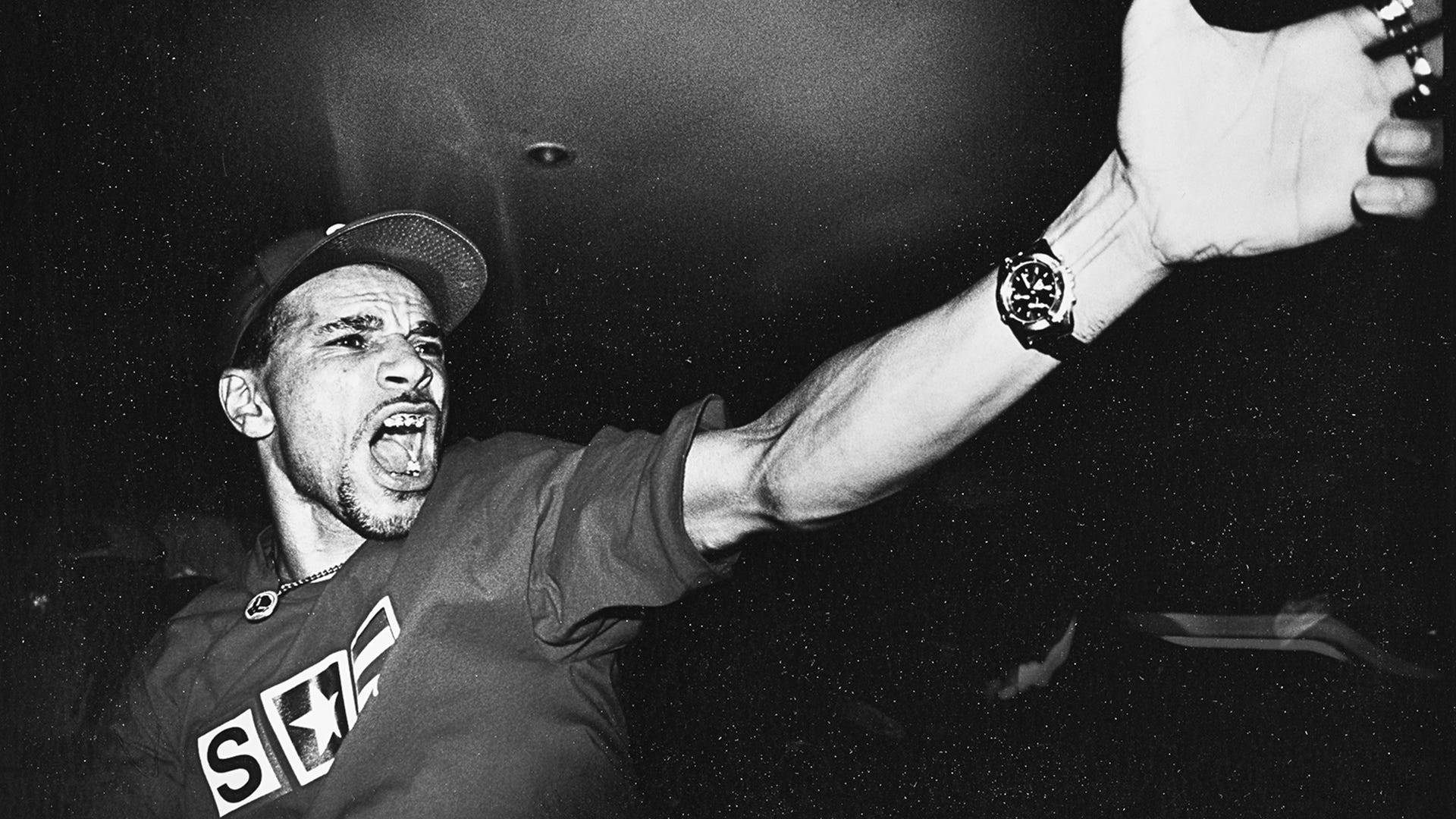
This week, Chase & Status headline Reading & Leeds alongside Charli XCX, Dave, RAYE, Florence + The Machine, and Fontaines D.C. On the same bill, Hybrid Minds, Hedex, Bou, and SOTA show how many different directions drum & bass now stretches in.
It’s a strange place for music that originated from pirate radio and soundsystem culture to end up. Drum & bass now fills arenas, Nia Archives’ Emotional Junglist reached the UK Top 40 this summer, Sub Focus’s Contact topped the Dance Albums Chart, and underneath all of it, the genre still runs the way it always has: independent labels, dubplates, and local radio still feeding a culture that never needed the charts to survive.
That’s really the story here. Drum & bass didn’t suddenly become mainstream. The mainstream finally caught up with it.
Before It Had a Name
Drum & bass started as a collision no one planned. As UK hardcore accelerated in the early ‘90s, producers started chopping breakbeats into more complex patterns and dropping heavier sub-bass underneath them: house, techno, hip-hop sampling, and reggae soundsystem culture all colliding at once.
Rage, the Thursday night Fabio and Grooverider ran at Heaven from 1988 to 1995, is where you could watch that collision happen in real time. New York house sat next to Belgian techno and dark instrumental breaks, with no real genre lines yet.
“We weren’t calling it anything but house”
— Grooverider
Pirate stations like Kool FM gave DJs and MCs a way to reach listeners without waiting for the mainstream to take an interest. Nights like AWOL, Roast, and Telepathy created places where new records could be tested immediately. Rewinds and MCs were lifted from reggae soundsystem and dropped into the rave.
By 1992, Fabio and Grooverider could already hear a split forming: one side going brighter and more pitched-up, the other darker and bassier. Jungle was becoming its own thing, and the line between jungle and what would later be called DnB was never drawn cleanly, and it still isn’t.
“It was a massive melting pot. No one was using the word jungle but that was where it started.”
— Fabio
The First Time the Mainstream Noticed
This isn’t drum & bass’s first brush with the charts. M-Beat and General Levy’s Incredible hit the UK Top 10 in 1994. This put ragga jungle in the singles chart while the music was still tangled up with pirate radio and raves.
A year later, Goldie’s Timeless reached No. 7 on the Albums Chart. Goldie wasn’t just making a record; he was making an argument.
“I have a job to do and my job is to make breakbeat more acceptable.”
— Goldie (Mixmag Interview 1995)
Metalheadz pushed the darker end; LTJ Bukem’s Good Looking Records pulled breakbeats toward jazz and ambience. Roni Size & Reprazent won the 1997 Mercury Prize, beating Radiohead, Spice Girls, and The Chemical Brothers.
“It felt like flying the flag for the entire drum’n’bass scene.”
— Size
For a moment it looked like drum & bass might become the defining British sound. Then UK garage rose, trance exploded, and the spotlight moved on. The genre didn’t disappear with it. That’s the pattern that’s repeated for three decades: recognition, retreat, return.
The Different Colours of Drum & Bass
Treating drum & bass as one sound is the easiest mistake to make with it.
“People that don’t know much about the genre might think it’s one specific thing; it’s actually so open.”
— Nia Archives
The split goes back almost to the beginning.
Good Looking Records pushed atmosphere and space, eventually labelled “intelligent” drum & bass, a term that never sat well with anyone given what it implied about everything else, but the music proved that speed did not have to mean aggression.
Liquid developed that idea further around the turn of the millennium. Fabio came up with “liquid funk” as producers like Calibre, High Contrast, GLXY, and London Elektricity brought soul, funk, vocals, and warmer melodies into their productions.
At almost the opposite end was techstep. Ed Rush & Optical pushed drum & bass towards colder, more mechanical territory, drawing from techno, sci-fi, and complex sound design. Ed Rush & Optical’s 1998 album Wormhole became one of the defining records in that development and a major foundation for what is now known as neurofunk. The lineage eventually runs through artists like Noisia and Mefjus.
Jump-up went somewhere else again: hook-driven, playful, and deliberately immediate. Labels like Urban Takeover, Formation, and True Playaz helped establish the sound in the 90s before Hazard and Generation Dub pushed it into another major period in the 2000s. Today, Hedex, Bou and SOTA have pushed jump-up into the biggest venues and festivals. Even within the scene, the boundaries are blurry: Hazard argued that some tracks labelled jump-up could just as easily be called dancefloor.
Dancefloor DnB itself has travelled the furthest into the mainstream, for the obvious reason that it was meant to. Pendulum brought rock dynamics and polished songwriting. Chase & Status, Wilkinson, Dimension, and Sub Focus combined the speed of the genre with melodic hooks, vocal structures, and production designed to work on festival stages.
And then there were producers moving in the opposite direction again. Around the end of the 2000s, dBridge and Instra:mental’s Autonomic project Autonomic project stripped DnB back towards sparse percussion, deep sub-bass, and influences from techno, dubstep, and experimental electronic music. Resident Advisor noted at the time that even calling some of it drum & bass didn’t feel right; “170 BPM bass music” and “minimal” were the labels being used instead.
None of these sounds attract exactly the same audience. Someone drawn to the warmth of Calibre could have little interest in neurofunk. A crowd waiting for a Hedex drop is looking for something different from someone listening to an Autonomic set.
However, they are connected by a shared language: breaks, bass, speed, and a culture that has spent more than thirty years finding new ways to rearrange them.
The Subgenres That Crossed Over
For all of DnB’s diversity, the move into the mainstream is not evenly distributed.
The mainstream success of dancefloor DnB makes sense: large vocal hooks, clear builds and releases, polished production, and versatile melodies. Pendulum helped establish that route in the 2000s, and artists like Sub Focus, Chase & Status, Dimension, and Wilkinson pushed it further into the mainstream, repeatedly breaking into the UK charts.
Liquid also found an easier route out. Its emphasis on vocals, melody, and emotion makes it one of the easiest subgenres to listen to without being immersed in the scene. Hybrid Minds have charted albums on exactly that appeal. The crossover is less obvious than dancefloor’s relationship with pop, but the distance between a vocal liquid track and the wider world of melodic electronic music is pretty small.
Jump-up has made the most dramatic leap recently. This sound used to be strongly associated with specialist raves, but is now part of major festival lineups and Top 40 charts.
But this trajectory does not describe the whole genre.
Neurofunk can bring huge audiences, but is almost absent from British pop culture. The same is true for deep and minimal DnB, and the more experimental edges of jungle. Their artists can headline specialist festivals, tour internationally, and build careers that last decades without ever producing something recognisable as a mainstream hit.
A Pattern, Not a Breakthrough
The 2000s and 2010s produced their own wave of crossover moments, and looking back, they seem less like one continuous rise than a cycle repeating on a loop.
Pendulum’s Hold Your Colour proved DnB could be played live in a band and reach rock crowds without losing itself.
“Pendulum managed to bottle something that had this mass appeal.”
— Sub Focus
Rudimental took Feel the Love to No. 1 in 2012; Sigma’s Nobody to Love topped the chart two years later; Wilkinson’s Afterglow became a long-running hit. These are records produced by drum & bass artists, heard by people who wouldn’t have called themselves DnB fans.
Between each of those moments, the genre was written off as past its peak with garage, dubstep, house, and techno taking the media’s attention instead. It didn’t matter much. Hospitality, RAM, Metalheadz, Hospital, Shogun Audio, and a long list of smaller labels kept releasing records regardless of who was paying attention. That’s the real difference between this current wave of visibility and a conventional comeback: there’s nothing to rebuild. The audience, the labels and the infrastructure never left.
Why It Doesn’t Sound Like Anything Else
Part of what’s kept drum & bass distinct is simply what it is. House and techno run on a steady 4x4 kick, which gives them room to work through repetition: a groove settles in, tension builds slowly. At 170–175 BPM with a broken beat, DnB does the opposite: kicks and snares shift constantly, breaks get chopped mid-bar, and the drums can feel frantic with the bassline underneath sitting at what feels like half the tempo. That gap between speed and weight is the whole sensation.
It’s also why the genre brings such a wide emotional range from one tempo: liquid can sound melancholic, jungle chaotic, neurofunk clinical, dancefloor euphoric, all using the same underlying structure. MCs have been central to a lot of it, responding to the crowd in real time in a way house and techno don’t ask for.
“You get it, and there’s nothing else like it.”
— Andy C
Nothing about the tempo fits neatly into the 4/4 genres around it, which might be exactly why so many different kinds of listeners end up finding their own way in.
A New Generation Finds It
The newest wave of drum & bass fans found the genre through completely different methods than the ones before them. A clip from a rave can reach millions within days, and a drop can go viral before the track’s even out. Listeners can move from hearing thirty seconds of a track online to finding decades of mixes, labels, and artists in an afternoon.
It would be easy to credit social media with the genre’s current popularity, but that would give the platforms too much credit.
Social media didn’t invent the culture. It just shortened the walk from outside it to inside it.
Artists like Bou, Hedex, SOTA, Lens, and A Little Sound have emerged into a world where specialist DnB success and mainstream visibility no longer feel like opposite career paths. A track can work first in a rave and then travel far beyond it, while the artist behind it can continue operating within the same scene that supported them in the first place.
“Jungle and drum n’ bass always existed in the underground and historically always had crossover tunes.”
— Nia Archives for NME in 2025
Nia Archives represents another version of this crossover. Her roots in jungle have taken her from small clubs to opening for Beyoncé, but instead of simply making jungle more commercially accessible, she has stretched it into other forms. On Emotional Junglist, breakbeats and bass combine with indie, alternative pop, and R&B. She now describes the record itself as alternative rather than purely jungle.
The internet has made the edges of the scene much easier to cross, but it has not removed them.
A new generation has not replaced the underground. It has found it, entered it and started changing it again.
What Does Underground Mean Anymore?
The bigger drum & bass gets, the harder it is to call it underground with a straight face, but that says more about what we assume the word means than about the genre itself.
For DnB, underground was never really about small audiences. It meant building your own infrastructure because the mainstream one wasn’t available: independent labels, pirate radio, dubplates, relationships between DJs and record shops that could sustain a career without radio airtime. Most of that infrastructure is still here, even with thousands more people paying attention. The risk isn’t popularit; it’s that the version of DnB that travels easiest starts to look like the whole genre, while some subgenres stay invisible outside the scene that already loves them. There’s also a history that needs to be remembered and respected. Jungle / drum & bass grew out of Black British culture and Caribbean soundsystem traditions, and some producers have been direct about how thin the general understanding of that history still is.
Where it goes next is hard to call, and that’s probably how it felt in the early 2000s. DnB has never had one dominant direction for long. When one strand gets too polished, another usually shows up to make it loud and rough again. This friction has been driving the genre for thirty years, not any single sound winning out.
The mainstream hasn’t swallowed drum & bass. It’s just run out of ways to ignore it. And underneath the festival slots and chart positions, the same machinery that kept the genre alive when nobody outside the scene was watching: The labels, DJs, MCs, pirate radio’s descendants, a few dozen people in a dark room on a Tuesday, are still what’s running it.
Drum & bass never needed and will never need mainstream attention to survive.